I typically do a “research foray” (usually by myself) when preparing to lead forays into the woods for neighbors and friends. The reason is two-fold:
First, I want to make sure there is a strong chance we will find good, edible mushrooms … and plenty of them. Recent rains, combined with beautiful and not-to-hot weather this week, have conspired to encourage Fall mushrooms to begin fruiting in abundance.
Second, in the area where I’ve led forays for more than two decades (a productive triangle about 2,500 feet in altitude, bordered by forest service roads in the Gifford Pinchot National Forest, southeast of Ashford, about a mile on each side) there are a variety of “zones.” Different types of mushrooms will move around from one zone to another in different years. I want to acquaint myself with the best places within my hunting area to find specific, choice edible mushrooms … so I can take you there!
My September 10 event was a 10:30 a.m. foray, about an hour and a half in length, into some of the most promising zones, followed by a trip up the mountain to check on huckleberries, and lunch, and then a trip back down to spend about an hour searching additional zones.
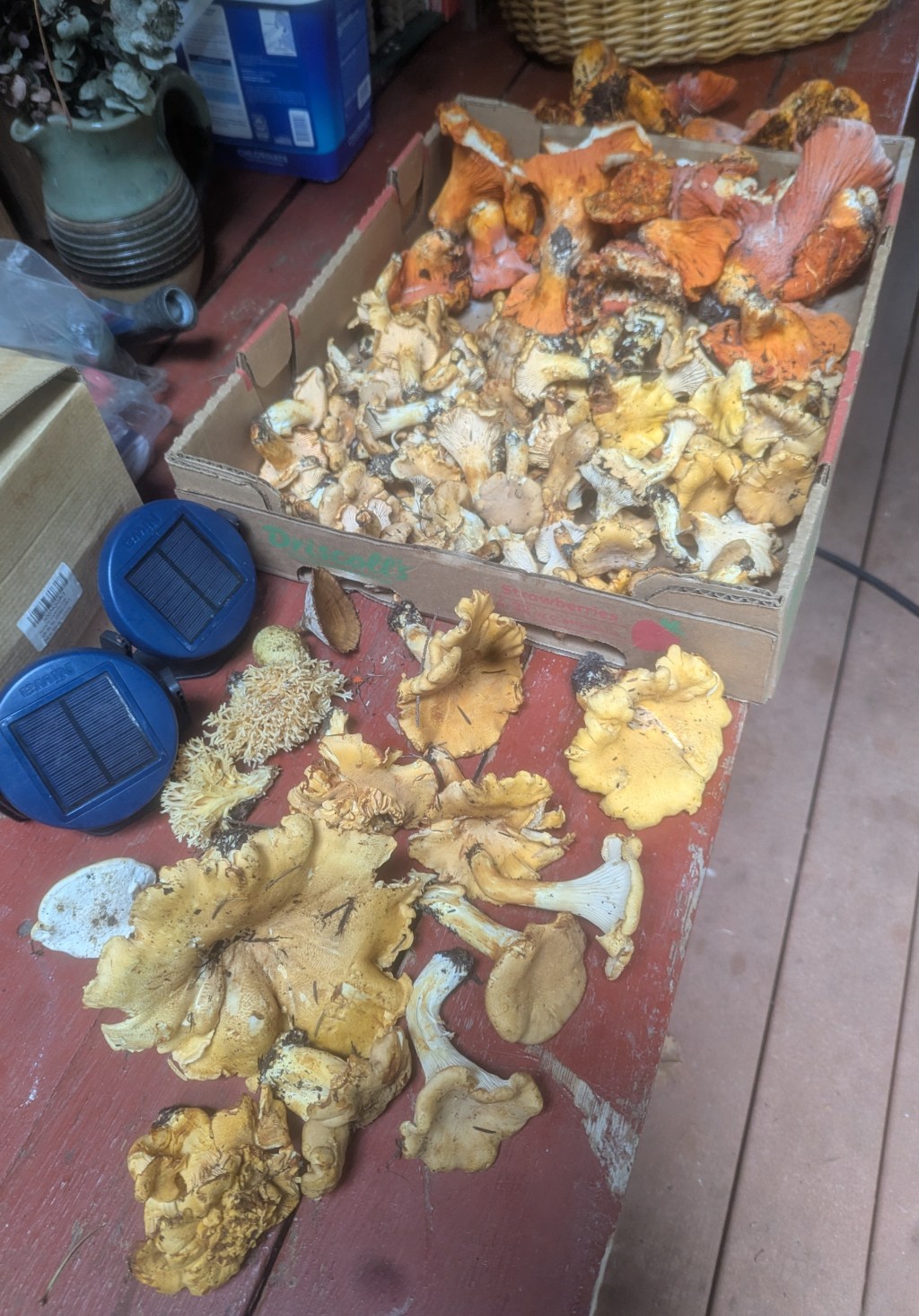
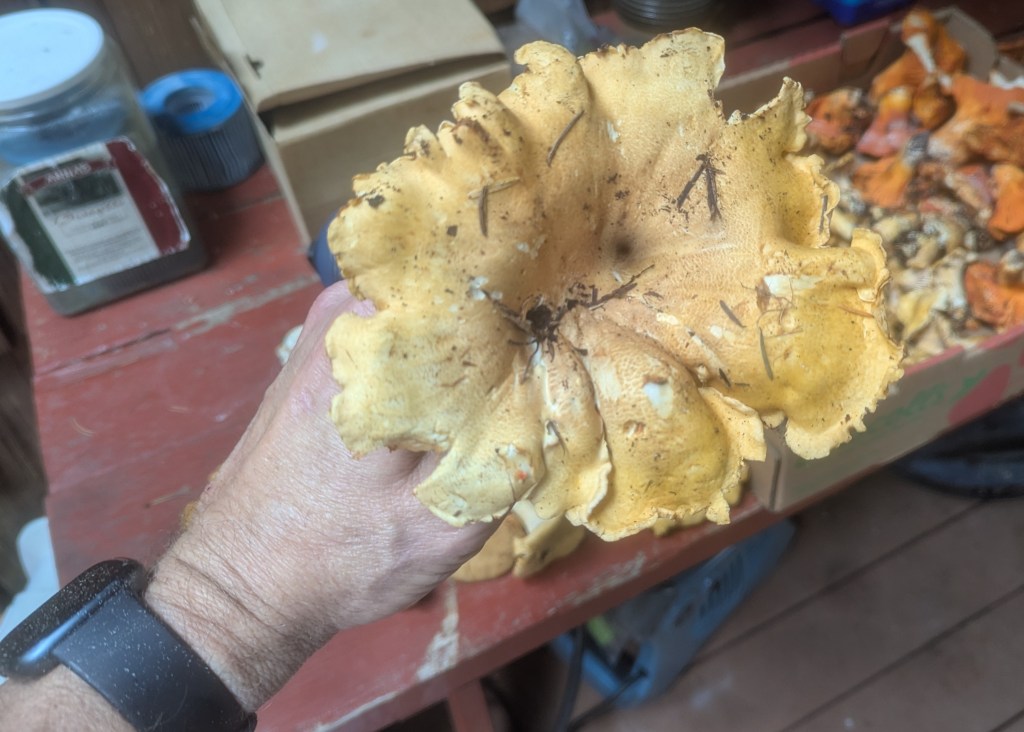
The results from my day are pictured above and below. I found quite a few Golden Chanterelles, some of extraordinary size (as you can see in the close-up of the one I am holding below).
In addition, the Lobster Mushrooms were going strong. (In case you are unfamiliar with Lobsters, they result from a relatively boring Russula brevipes white mushroom which is infested by the Lactiflourum fungus, which expodes it in size, turns it bright red, and gives it the distinctive flavor of lobster!.) Coral (club) mushrooms were beginning to pop up, but while I consider these pretty (an example included to the upper left of the large Chanterelles in the photo on top of this post), I don’t consider them choice edibles.
Many of my favorites (in addition to Chanterelles and Lobsters) appear when the weather gets a little wetter and cooler … most notably Hedgehogs (a spine mushroom related to Lion’s Mane, which grows at higher elevations), various boletes and puffballs, and rarer unusual things like Elfin Saddles and Cauliflower Mushrooms. I didn’t see any of those (except for a few puffballs) happening yet, and didn’t really expect to. Some years (like last year) we are awash in nice boletes, but other than a few early examples which had already withered, I didn’t see any.
But the Chanterelles and Lobsters are going strong, so if you are interested in these most popular fall specimens, I am going to start signing guests up for two-hour forays per the schedule I published earlier.
Please do reach out to me on email and let me know if you are interested. There is no charge for forays, which are first-come, first-served, though I accept donations (in return for nice coffee-in-the-forest Mushroom Obsession-branded mugs) to defray costs.
And the usual caveat: Although I have been learning about and hunting wild edible mushrooms for more than two decades, I consider myself a hobby mushroom forager and not a trained expert. And I always advise consulting with an expert before consuming any mushrooms that you harvest in the wild.
On your foray, we will talk more about safety tips and good forest etiquette (such as “leave no trace”).

 Mushroom Obsession
Leave a comment