I’m going to depart for a moment from my usual topic (mushrooms, of course) to talk about a plant that I once considered a major irritation (quite literally), but have grown increasingly fond of over the years I’ve grown to know it: the Devil’s Club.
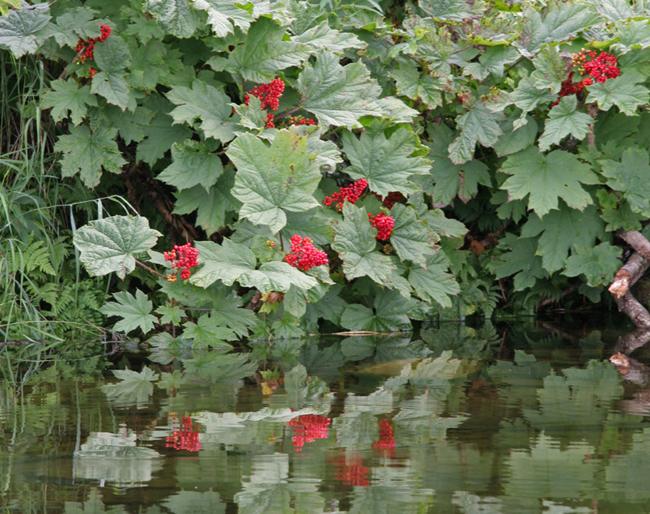
Devil’s Club (Oplopanax horridus) is a very prehistoric-looking, large-leafed, spine-covered shrub that grows in abundance in soggy, marshy and shady areas often simultaneous with many of the Fall mushrooms we hunt here in the Northwest. (It primarily grows here in the Pacific Northwest, although some have been found on islands in the Great Lakes, several thousand miles to the east.)
During Fall forays, when I see Devil’s Club, I always start scanning the forest floor beneath and near them for Chanterelle, Lobster, and other favored Fall mushrooms.
But I always warn foray participants to beware of touching the plant due to its many small spines (growing on the underside of leaves and on mature stems) which can be highly irritating to the skin and can cause infections or allergic reactions. I usually wear fairly heavy-duty trousers when hunting, but have even been poked through the fabric if I brush up against a plant.
However, over time I’ve learned that Devil’s Club can be very useful if carefully harvested, in at least one regard. And most recently I’ve also learned that it was held in high respect by indigenous populations here in the Northwest (where it primarily grows at altitude) for its many medicinal purposes. Some parts are even considered edible.
Devil’s Club can grow (slowly) to 10 feet in height, although it averages half that. When it is mature, the stems are quite hard and woody. When whittled down, they are beautifully white, with interesting knobs and curvatures, and the resulting wood (if you can find a club at least 1 inch in thickness) is very strong and light. Hence they make wonderful walking sticks. No two Devil’s Club walking sticks are identical, and their varied shapes give them a whimsical appearance.
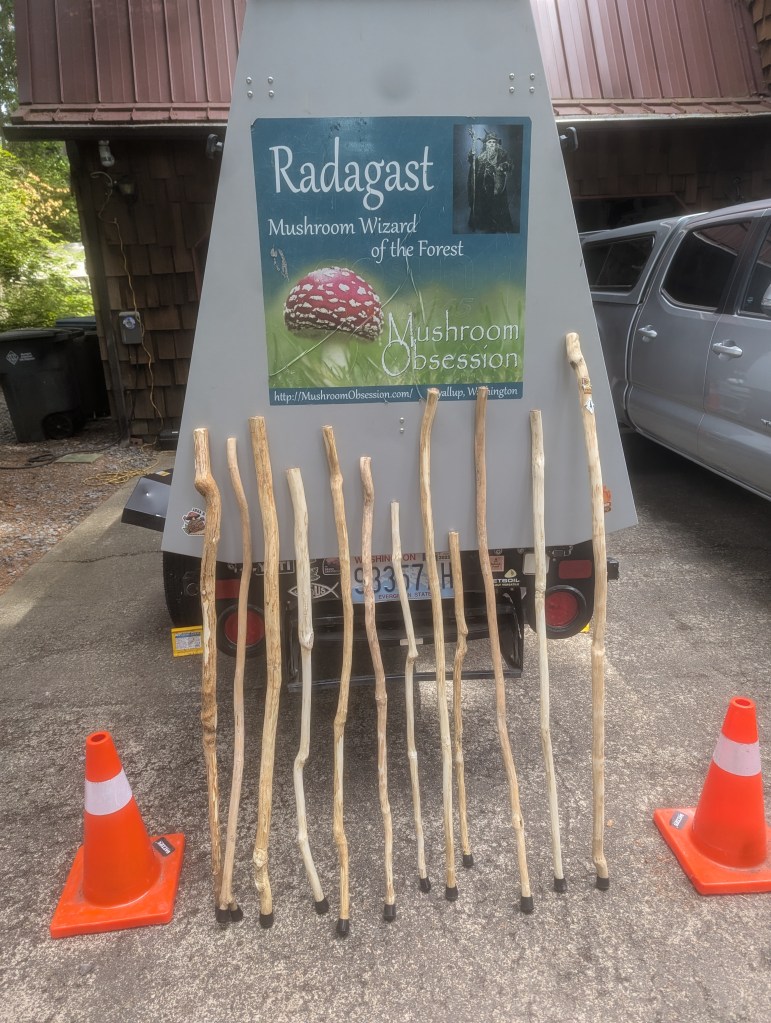
Here are a dozen walking sticks made from Devil’s Club which I am currently working on. The one on the far right is my favorite, the one I always hike with. It bears badges from Zion National Park and the Pacific Crest Trail.
I’ve shown off their strength to many by trying to break a good-sized club over my knee … and I’ve only succeeded once!
A good friend (who is quite artistic) got me started by giving me a treasured gift of a lovely Devil’s Club walking stick that he had whittled for me. It even had a carved hand-grip and beautifully painted depictions of my favorite mushrooms!
I added “hiking badges” representing the various trails (such as the Pacific Crest, the Appalachian, and many more) that I have hiked. A treasured possession, I lost this walking stick somewhere in a forest on the slopes of Mt. Rainier a few years back, but always keep my eyes open for it while hiking. I still hold out hope to reacquire it some day.
Since then, I have carved several dozen of my own, and often give them as gifts or lend them to foray participants. (I find a walking stick very useful for helping negotiate challenging terrain.) When I find a sufficiently mature Devil’s Club to harvest I use a handsaw and thick gloves to remove it, and a potato peeler which makes it easy to remove the spiny skin from the stems. Once home I use my bench grinder to polish the cut surfaces (the ends have a unique white “eye” in the center) and round out some of the nobbiness. After I get a club sufficiently pared down with the potato peeler, I let it dry, then hand-sand the club down to a smooth texture. Once it is completely dry and ready to go I apply a low-gloss wood sealant and tip the club off at the bottom end with rubber chair tips which you can obtain in various dimensions at the hardware store. (If you use a favored club a lot, as I do, these will have to be replaced every few months.)
Moving Beyond Walking Sticks
I recently read up on other uses for Devil’s Club. They bear beautiful red berries, but these are NOT edible. What is edible, according to Northern Bushcraft, are the roots, and also the young stems when they are tender (before spines grow), or young leaves that do not yet have spines.
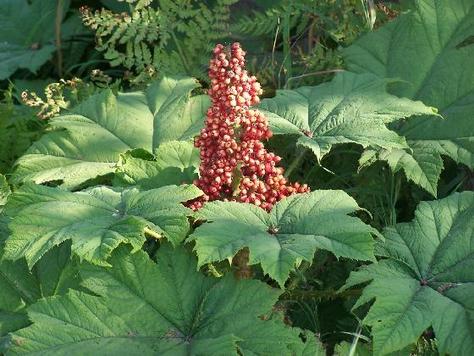
When first harvested, the fresh stems have a very pungent and unique odor (not really pleasant until you get used to it). WebMD says some believe Devil’s Club can help heal arthritis, cancer, wounds, fever, tuberculosis, stomach problems, cough, colds, sore throats, diabetes, low blood sugar, and pneumonia. It is also used for emptying the bowels and causing vomiting (I’m assuming by eating the toxic berries).
Some of the commenters on that WebMD article attest to its effectiveness at addressing blood sugar and weight loss issues. (I am a Type 2 diabetic so I will give it a try!)
Some people apply Devil’s Club poultices directly to the skin to address swollen glands, boils, sores, and infections. The ashes have been used to treat burns, and in addition indigenous peoples create ceremonial skin paint from these ashes.
WebMD says Devil’s Club contains chemicals that might help prevent certain cancer cells from growing, and fight some bacteria, fungi, and viruses.
I will continue to research the edibility, preparation and effectiveness of Devil’s Club, and will report back! In the meantime, happy hunting, and watch out for those nasty spines!

 Mushroom Obsession
Leave a comment